Plate 4:Arch Street Ferry
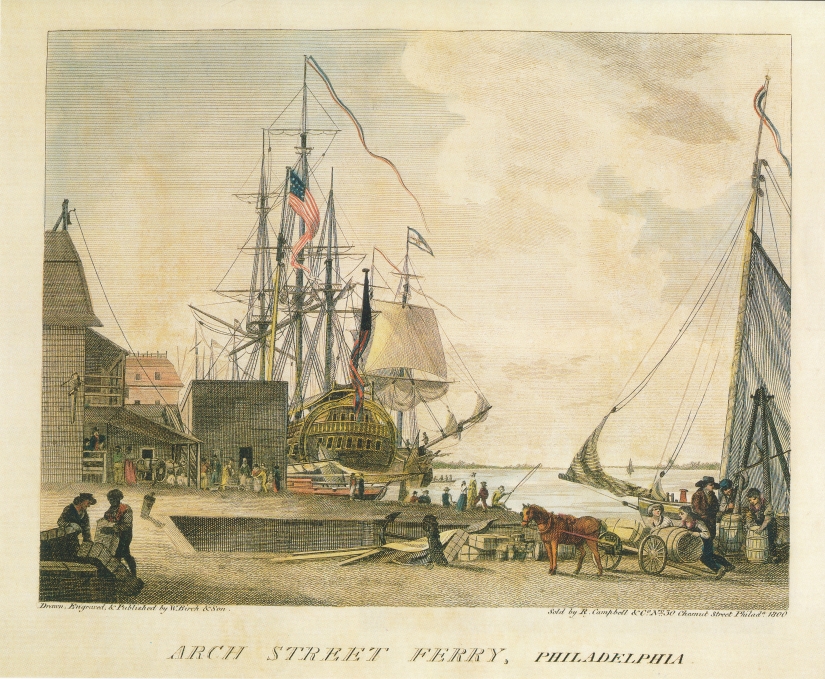
View in 1800
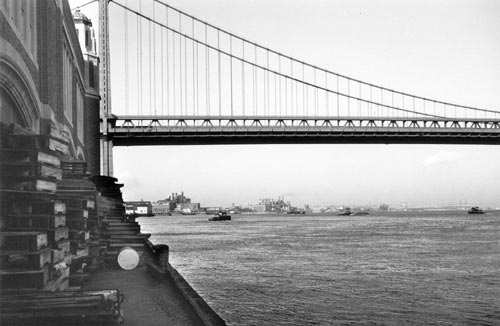
View in 1960
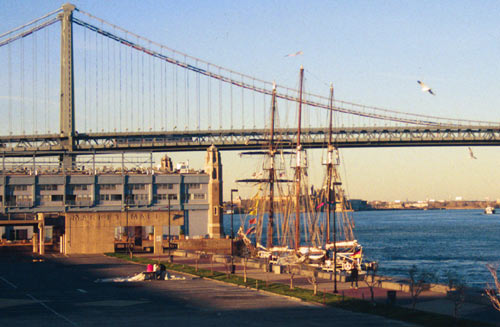
View in 2000
Engraving
At the foot of Arch Street was a terminal for the Cooper Family's ferry (FG-R). This and other ferries were the transportation links with southern New Jersey villages and farms which provided much of the produce sold in the markets along High Street (now Market Street). From this point in 1790 John Fitch's steamboat, the first watercraft to be successfully powered by steam, began a regular service carrying passengers to Bristol, PA, Burlington, NJ and Trenton, NJ. The warehouse and wharf lined with ships (BG-L) are believed to have belonged to Stephen Girard, a merchant-banker and ship owner who prospered in the China and East India trade (see commentary, Plate 17).
Photographs
From the early years of the eighteenth century, Philadelphia's waterfront fueled a vital mercantile and industrial economy, By 1967 technological developments, like containerization shipping, had made useless the old municipal piers along the river near Center City. The working port moved to modern terminals at Packer Avenue in 1968 and at Tioga in 1972, and city planners decided that the obsolete piers would be redeveloped. A mile long stretch of river bank from Lombard Street north to Market was christened "Penn's Landing," an homage to the unmarked location (long since filled in) where Penn came ashore in 1682 (actually believed to have been at the foot of Spruce Street at Dock Creek). Penn's Landing is still a "work in progress." The 1960 photograph was taken from the end of Pier 5 North. The 2000 photograph shows that pier converted into residential condominiums (MG-L), and the northern end of Penn's Landing (FG-L) which is the future site of the Please Touch Museum, a proposed terminal for an aerial tramway to Camden, and a portion of the planned Family Entertainment Center. Completed projects south of this location include: The Philadelphia Ship Preservation Society's Historic Tall Ship Gazela of Philadelphia; the Independence Seaport Museum with its historic ships, the cruiser U.S.S. Olympia, Admiral Dewey's flagship at the battle of Manila Bay, 1898, and the submarine U.S.S. Becuna; a marina, esplanade, amphitheater, parks, restaurants and a Hyatt hotel nearing completion. The adjacent Columbus Boulevard (formerly Delaware Avenue) has been extensively landscaped, including bridges over Interstate Highway 95. After being restored and altered as a ship museum, the World War II battleship U.S.S. New Jersey, built in Philadelphia 1942-43, will be permanently berthed on the Camden waterfront opposite the south end of Penn's Landing.
Back Next