
Plate 2: Frontispiece: The City & Port of Philadelphia, on the River Delaware from Kensington

View in 1800

View in 1960
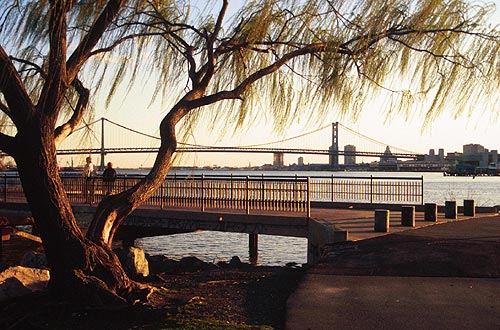
View in 2000
Engraving
Philadelphia in 1800, was culturally and commercially the most eminent city in America. It had hosted the First Continental Congress, 1774-75, and the Second in 1776. After the Revolution, remaining as the seat of government, it hosted the Constitutional Convention of 1787, and from 1790 to 1800 it served as the new nation's temporary capital. Birch's twenty-seven engravings reproduced in this book handsomely document the city's beauty and vitality at the close of the 18th century. His frontispiece immortalizes the image of the great elm tree at the legendary site of William Penn's treaty in 1682 with the Indians. In 1810, the elm was felled by storm. The willow tree in the 2000 photograph, planted about one hundred fifty years later, is almost a mirror image of the "Treaty Elm." Penn received the charter for Pennsylvania from Charles II in 1681 in recompense for a loan made to the king by his father, Admiral William Penn, for whom Pennsylvania was named. Although the land belonged to Penn by virtue of the charter, instead of forcibly taking it from the Indians, he sought peace and paid them one thousand pounds sterling. By the standards of the day the price was generous. But according to noted historians, Mary and Richard Dunn, Penn believed that he had purchased all the claims of the Delawares in what is now Philadelphia, Chester and Bucks Counties. The Indians, however, had no concept of exclusive land ownership. They thought they had sold the white men merely the right "to share the use of the land." Nevertheless, Penn maintained peaceful relations and never felt the need to fortify against the Indians.
Photographs
No shipping appears in either of the photographs which were taken from "Treaty Tree Park" in Kensington (a section of Philadelphia), but the Delaware River port system, including facilities in Pennsylvania, New Jersey and Delaware, remains a vibrant shipping region. Busy modern terminals lie to the north and south of this stretch of the river. Additions to the downriver skyline since 1960 are (L to R): Penn's Landing Hyatt-Regency Hotel, under construction; the one remaining "Southwark Tower," completed in 1963 for public housing, now private for low income (two other "Towers" were imploded in January 2000); and the three "Society Hill Towers" (see 2000 view, Plate 16). In 1983 the covered pier (FG 1960) was removed, the slip filled in and the shoreline reconfigured. In 1985, the fishing pier (FG 2000) was constructed.
Commentary and modern photographs by S. Robert Teitelman, copyright S. Robert Teitelman, from Birch's Views of Philadelphia, 200th anniversary edition, 2000. The Birch engravings and Birch's own text, published in 1800, are in the public domain.