



2f. The House of Burgesses
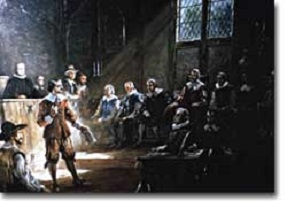
After his arrival in Jamestown in 1619, Governor George Yeardley immediately gave notice that the Virginia colony would establish a legislative assembly. This assembly, the General Assembly, first met on July 30, 1619.
Although many differences separated Spain and France from England, perhaps the factor that contributed most to distinct paths of colonization was the form of their government.
Spain and France had absolute monarchies, but Britain had a limited monarchy. In New France and New Spain, all authority flowed from the Crown to the settlers, with no input from below.
More Information ...
An absolute monarchy is a state in which the monarch has sovereign power and controls all aspects of government without being checked by any representative assemblies.A limited or constitutional monarchy is a state in which the power of the monarch is checked by other constitutionally sanctioned institutions, such as a representative assembly (e.g., the British Parliament).

The English kings who ruled the 13 original colonies reserved the right to decide the fate of their colonies as well, but not alone. The colonists drew upon their claims to traditional English rights and insisted on raising their own representative assemblies. Such was the case with the Virginia House of Burgesses, the first popularly elected legislative body in the New World.
 | ||
 |
But forasmuch as men's affaires doe litle prosper where God's service is neglected, all the Burgesses tooke their places in the Quire till a prayer was said by Mr. Bucke, the Minister, that it would please God to guide and sanctifie all our proceedings to his own glory and the good of this Plantation ... The Speaker ... delivered in briefe to the whole assembly the occasions of their meeting. Which done he read unto them the commission for establishing the Counsell of Estate and the general Assembly, wherein their duties were described to the life ... And forasmuch as our intente is to establish one equall and uniforme kinde of government over all Virginia &c. – John Pory, "A Reporte of the Manner of Proceeding in the General Assembly Convented at James City" (July 30, 1619) | |
 | ||
The Magna Carta
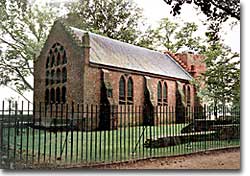
The General Assembly (which later established the House of Burgesses), the first legislative assembly in the American colonies, held its first meeting in the choir at Jamestown Church in the summer of 1619. Its first order of business: setting a minimum price for the sale of tobacco.
English landowners had insisted on meeting with their leaders for consultation in local matters ever since the Magna Carta was signed in 1215. Virginia settlers expected that same right.
Modeled after the English Parliament, the General Assembly was established in 1619. In 1643 it became a bicameral body, establishing the House of Burgesses as one of its two chambers. Members would meet at least once a year with their royal governor to decide local laws and determine local taxation.
House of Burgesses
In April, 1619, Governor George Yeardley arrived in Virginia from England and announced that the Virginia Company had voted to abolish martial law and create a legislative assembly, known as the General Assembly — the first legislative assembly in the American colonies. The General Assembly first met on July 30, 1619, in the church at Jamestown. Present were Governor Yeardley, Council, and 22 burgesses representing 11 plantations (or settlements) Burgesses were elected representatives. Only white men who owned a specific amount of property were eligible to vote for Burgesses. In 1643, the General Assembly became a bicameral body, establishing the democratically-elected House of Burgesses as its lower house, while the royally-appointed Council of State served as the upper house of the legislature.
King James I, a believer in the divine right of monarchs, attempted to dissolve the assembly, but the Virginians would have none of it. They continued to meet on a yearly basis to decide local matters.
Democracy in Practice
What is the importance of a small legislative body formed so long ago? The tradition established by the House of Burgesses was extremely important to colonial development. Each new English colony demanded its own legislature in turn.
Historians often ponder why the American Revolution was successful. The French, Russian, and Chinese Revolutions each ended with a rise to power of a leader more autocratic than the pre-revolutionary monarch.
Famous Burgesses
There have been hundreds of members of Virginia's House of Burgesses. Among the most famous are: Peyton Randolph, William Byrd, George Washington, Thomas Jefferson, Edmund Pendleton, and Patrick Henry.
But starting with the Virginia General Assembly, Americans had 157 years to practice democracy. By the time of the Declaration of Independence, they were quite good at it.
Instant Quiz