
2e. War and Peace with Powhatan's People

Fortunately for the English settlers, Powhatan had a plan.
He regarded the English settlers suspiciously, as he had previously regarded Spanish settlers. But the English had guns and powder. These items might just give him the advantage he needed to defeat surrounding tribes.
And the English seemed so harmless at first. If it were not for the good nature of Powhatan's people, the English settlers never would have survived their first few seasons in the New World. Good relations with these new inhabitants might help forge a powerful alliance.
The Powhatans
The Powhatan Confederacy comprised 30 tribes living along Virginia's coastal plain. Chief Wahunsonacock, called Powhatan by Captain John Smith, united the tribes to form the Powhatan Confederacy. At the time of Smith's appearance in Virginia, the Powhatans numbered about 12,000 people.
Tribes of the Powhatan Confederacy are called Algonquian because their languages were based on a large Native American language group called Algonquin.
Plundering, Peace, and Pocahontas
Before long, Powhatan's hopes were dashed. During the "starving time," colonists took to raiding Native American food supplies. In retaliation, Powhatan ordered an attack.

War raged on and off for the next few years with unspeakable brutality committed by both sides. Unsuspecting colonists were riddled with arrows. Children of defeated tribes were drowned in the James River.
Finally, in 1614, Powhatan accepted peace with the English. His daughter Pocahontas, after being kidnapped and ransomed, was married to John Rolfe and taken to England. Unfortunately, she died of disease only three years later. Powhatan died in despair in 1618.
 | ||
 |
So it is, that some ten years ago being in Virginia, and taken prisoner by the power of Powhatan their chief King, I received from this great Salvage exceeding great courtesy, especially from his son Nantaquaus, the most manliest, comeliest, boldest spirit, I ever saw in a Salvage, and his sister Pocahontas, the Kings most dear and well-beloved daughter, being but a child of twelve or thirteen years of age, whose compassionate pitiful heart, of my desperate estate, gave me much cause to respect her... – John Smith, "Letter to Queen Anne regarding Pocahontas" (1616) | |
 | ||
Powhatan's brother, Opechancanough, was determined to continue the fight. On Good Friday in 1622, he led an attack that nearly finished the Jamestown colony. Three hundred forty-seven settlers were killed before the situation stabilized.
Fighting continued between the Algonquian peoples and the English until 1645. Opechancanough was captured and executed. The English forced the tribes of the warring confederacy to cede land and recognize English authority.
No-Man's-Land

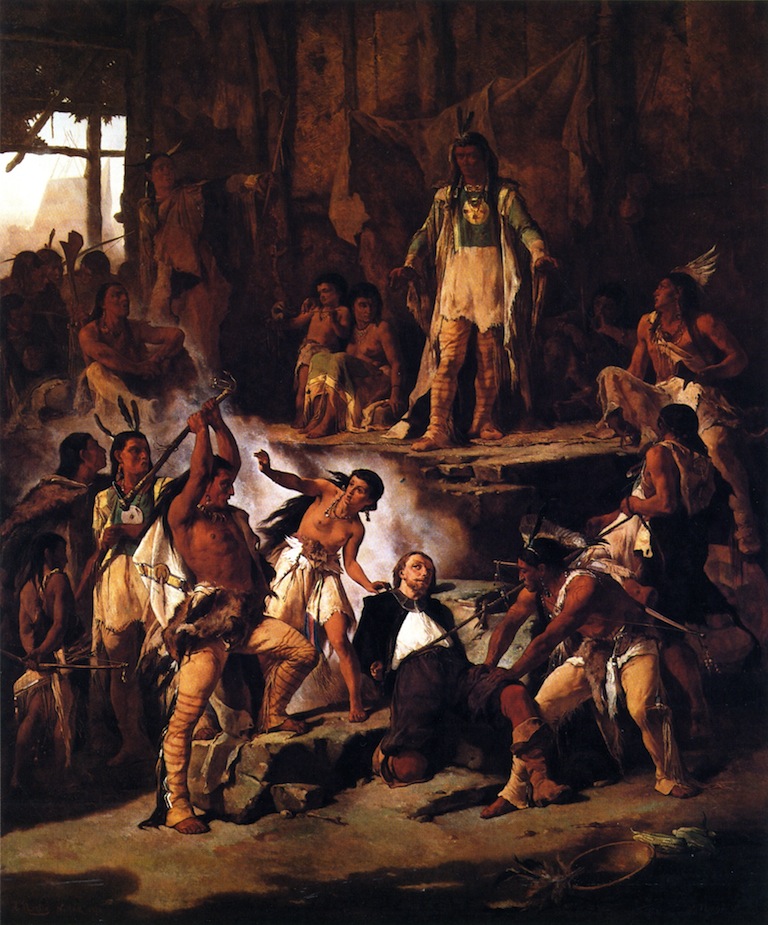
Many cultural differences separated the Native Americans and the colonists. The most important contrast was each side's differing view of land ownership. According to Powhatan's people, land was owned by no one; rather, it was collectively used by the tribe.
Because land could not be owned, it could not be sold or yielded in treaty. Selling land was the equivalent of selling air.
The English view of individual land ownership was completely foreign to the Powhatans, who could not understand being pushed off tribal lands so it could be sold to individuals. To the Powhatans, the loss of their land was a matter worth fighting for.
Population Elimination
Warfare and disease eliminated about 90% percent of the Native American population in Virginia within the first 60 years of English settlement.