



3a. The Mayflower and Plymouth Colony
Not all the English Separatists set out for the New World.
The first group to leave England actually headed for the Dutch Netherlands in 1608. They became uneasy in their new land as their children started speaking Dutch and abandoning English traditions. Even worse to the Separatists, the tolerance shown to them by the Dutch was shown to many different faiths. They became disgusted with the attention paid to worldly goods, and the presence of many "unholy" faiths.
The great Separatist experiment in the Netherlands came to a quick end, as they began to look elsewhere for a purer place to build their society. Some headed for English islands in the Caribbean. Those who would be forever known to future Americans as the Pilgrims set their sights on the New World in late 1620.
Crossing the Atlantic
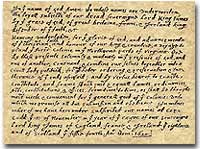
The Mayflower Compact, signed aboard the ship on its way from England to the New World, acknowledged their loyalty to the King and pledged their obedience to such just and equal laws as would be necessary to the general good of the colony to be established after landing. This document represents the first example of a written constitution in North America.
Over a hundred travelers embarked on the voyage of the Mayflower in September 1620. Less than one third were Separatists. The rest were immigrants, adventurers, and speculators.
When the weather was good, the passengers could enjoy hot food cooked on deck. When there was high wind or storms, they lived on salted beef, a dried biscuit called "hard tack," other dried vegetables, and beer. The nearest thing to resemble a bathroom was a bucket.
Their voyage took about two months, and the passengers enjoyed a happier experience than most trans-Atlantic trips. One death was suffered and one child was born. The child was named Oceanus after the watery depths beneath them.
Are We There Yet?
One of the greatest twists of fate in human history occurred on that epochal voyage. The Pilgrims were originally bound for Virginia to live north of Jamestown under the same charter granted to citizens of Jamestown. Fate charted a different course. Lost at sea, they happened upon a piece of land that would become known as Cape Cod. After surveying the land, they set up camp not too far from Plymouth Rock. They feared venturing further south because winter was fast approaching.
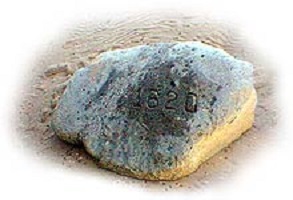
The 102 travellers aboard the Mayflower landed upon the shores of Plymouth in 1620. This rock still sits on those shores to commemorate the historic event.

The Pilgrims had an important question to answer before they set ashore. Since they were not landing within the jurisdiction of the Virginia Company, they had no charter to govern them. Who would rule their society?
In the landmark Mayflower Compact of 1620, the Pilgrims decided that they would rule themselves, based on majority rule of the townsmen. This independent attitude set up a tradition of self-rule that would later lead to town meetings and elected legislatures in New England.
Like the Virginia House of Burgesses established the previous year, Plymouth colony began to lay the foundation for democracy in the American colonies.