



34b. Wartime Diplomacy
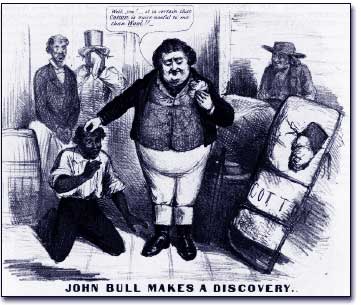
A Northern commentary on foreign relations, this political cartoon shows England (John Bull) forsaking its stand against slavery when tempted by Southern cotton.
Rebellions rarely succeed without foreign support. The North and South both sought British and French support. Jefferson Davis was determined to secure such an alliance with Britain or France for the Confederacy. Abraham Lincoln knew this could not be permitted. A great chess match was about to begin.
Cotton was a formidable weapon in Southern diplomacy. Europe was reliant on cotton grown in the South for their textile industry. Over 75% of the cotton used by British came from states within the Confederacy.
By 1863, the Union blockade reduced British cotton imports to 3% of their pre-war levels. Throughout Europe there was a "cotton famine." There was also a great deal of money being made by British shipbuilders. The South needed fast ships to run the blockade, which British shipbuilders were more than happy to furnish.
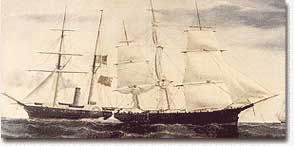
The Emily St. Pierre a blockade runner operated by a firm specializing in importing supplies to the Confederacy, was the one of the first ships to fly a Confederate flag in Liverpool, England. It also flew the Confederate flag while docked in Calcutta, India.
France had reasons to support the South. Napoleon III saw an opportunity to get cotton and to restore a French presence in America, especially in Mexico, by forging an alliance.
But the North also had cards to play. Crop failures in Europe in the early years of the war increased British dependency on Union wheat. In 1862, over one-half of British grain imports came from the Union. The growth of other British industries such as the iron and shipbuilding offset the decline in the textile industry. British merchant vessels were also carrying much of the trade between the Union and Great Britain, providing another source of income.
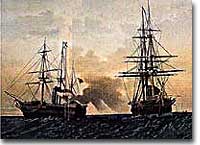
The capture of Confederate diplomats aboard the British ship, the Trent by the U.S.S. Jacinto was at first celebrated by Congress. When it became evident that the action nearly caused an international incident, the prisoners were released.
The greatest problem for the South lay in its embrace of slavery, as the British took pride in their leadership of ending the trans-Atlantic slave trade. To support a nation that had openly embraced slavery now seemed unthinkable. After the Emancipation Proclamation, Britain was much less prepared to intervene on behalf of the South.
The key for each side was to convince Europe that victory for its side was inevitable. Early Southern victories convinced Britain that the North couldn't triumph against a foe so large and so opposed to domination. This was a lesson reminiscent of the one learned by the British themselves in the Revolutionary War. Yet, despite all its victories, the South never struck a decisive blow to the North. The British felt they must know that the South's independence was certain before recognizing the Confederacy. The Southern loss at Antietam loomed large in the minds of European diplomats.
Yet efforts did not stop. Lincoln, his Secretary of State William Seward, and Ambassador Charles Francis Adams labored tirelessly to maintain British neutrality. As late as 1864, Jefferson Davis proposed to release slaves in the South if Britain would recognize the Confederacy.