11a. American and British Strengths and Weaknesses
The question remains: What factors led an undisciplined, unprepared, divided American nation to prevail over the world's largest empire?
British Strengths and American Weaknesses
The British seemed unbeatable. During the previous 100 years, the British had enjoyed triumph after triumph over nations as powerful as France and Spain. At first glance, the odds were clearly against the Americans. A closer look provides insight into how the underdogs emerged victorious.
Britain's military was the best in the world. Their soldiers were well equipped, well disciplined, well paid, and well fed. The British navy dominated the seas. Funds were much more easily raised by the Empire than by the Continental Congress.
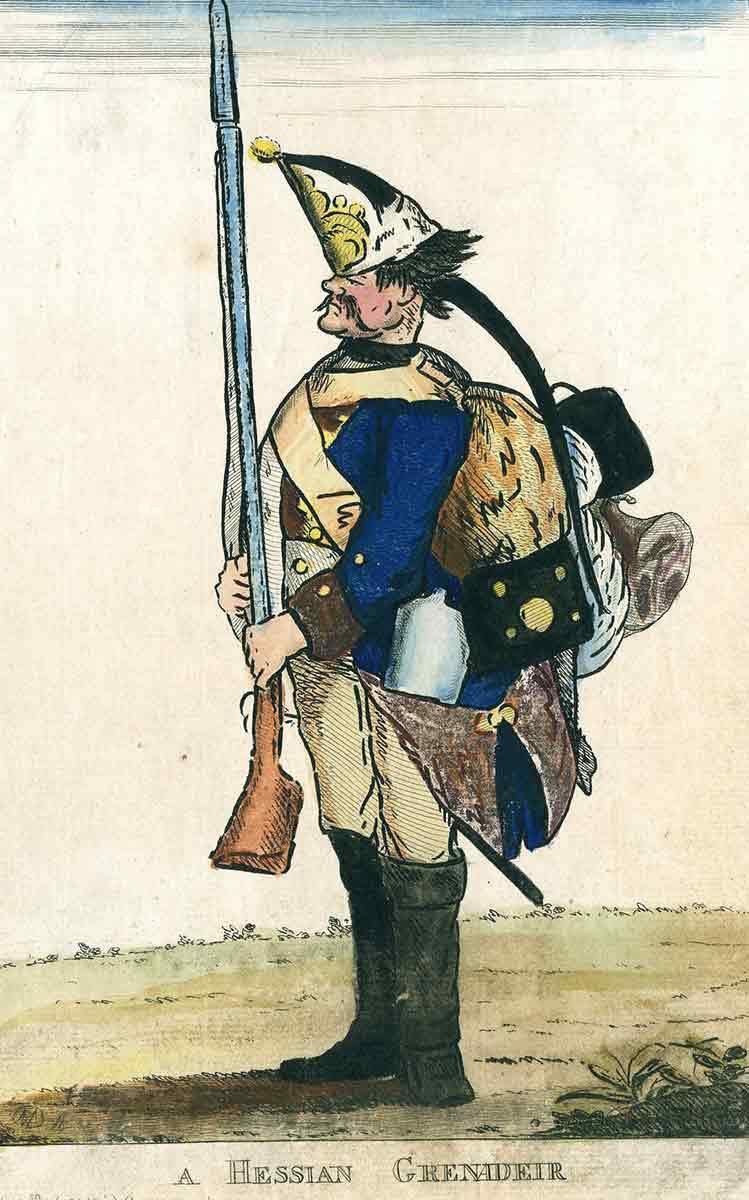
Some of those funds were used to hire Hessian mercenaries to fight the Americans.
|
... and the Hessians, who are allowed to be the best of the German troops, are by no means equal to the British in any respect. I believe them steady, but their slowness is of the greatest disadvantage in a country almost covered with woods, and against an Enemy whose chief qualification is agility in running from fence to fence and thence keeping up an irregular, but galling fire on troops who advance with the same pace as at their exercise. Light infantry accustomed to fight from tree to tree, or charge even in woods; and Grenadiers who after the first fire lose no time in loading again, but rush on, trusting entirely to that most decisive of weapons the bayonet, will ever be superior to any troops the Rebels can bring against them. Such are the British, and such the method of fighting which has been attended with constant success .... 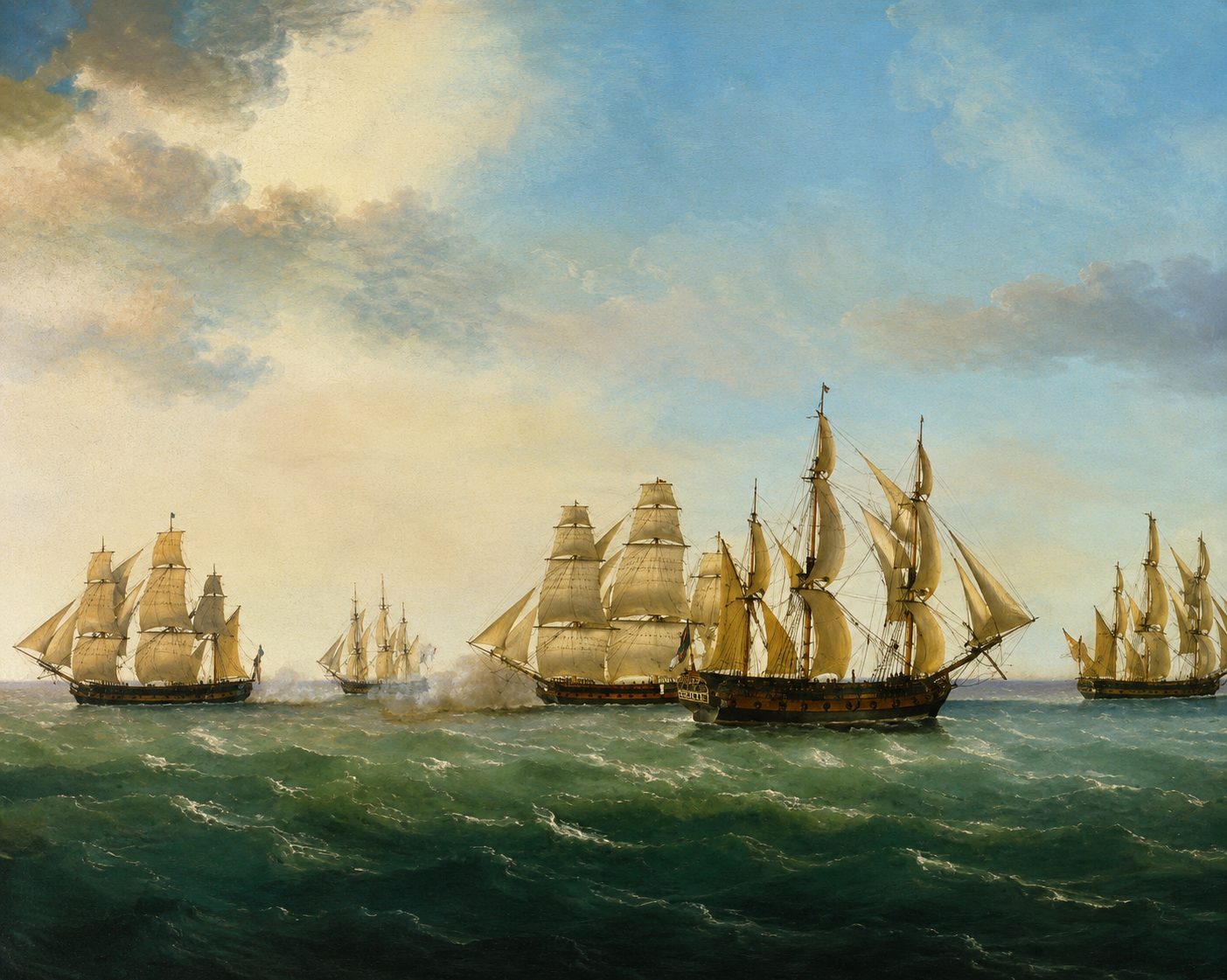 Francis Holman, USS Boston and Hancock vs. HMS Flora and Rainbow, 7 July 1777, 1779 Although the Royal Navy dominated the seas during the Revolutionary War, American naval forces occasionally won remarkable victories against Britain's more powerful fleet. This painting depicts the engagement of July 7, 1777, between the American frigates Hancock and Boston and the British frigates Flora and Rainbow. While these naval victories were celebrated by the Americans, they were rare and the British enjoyed a distinct naval superiority.– Lieutenant W. Hale, letter to unknown recipient (March 23, 1778) | ||
The Americans had tremendous difficulty raising enough funds to purchase basic supplies for their troops, including shoes and blankets. The British had a winning tradition. Around one in five Americans openly favored the Crown, with about half of the population hoping to avoid the conflict altogether. Most Indian tribes sided with Britain, who promised protection of tribal lands.
American Strengths and British Weaknesses
On the other hand, the Americans had many intangible advantages.
The British fought a war far from home. Military orders, troops, and supplies sometimes took months to reach their destinations. The British had an extremely difficult objective. They had to persuade the Americans to give up their claims of independence. As long as the war continued, the colonists' claim continued to gain validity. The geographic vastness of the colonies proved a hindrance to the British effort. Despite occupying every major city, the British remained as at a disadvantage.
Americans had a grand cause: fighting for their rights, their independence and their liberty. This cause is much more just than waging a war to deny independence. American military and political leaders were inexperienced, but proved surprisingly competent.

The war was expensive and the British population debated its necessity. In Parliament, there were many American sympathizers. Finally, the alliance with the French gave Americans courage and a tangible threat that tipped the scales in America's favor.