



33d. Sacred Beliefs
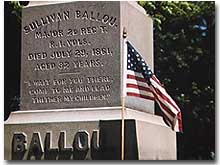
The letter that Union soldier Major Sullivan Ballou wrote to his wife, Sarah, a week before the First Battle of Bull Run expressed his belief that he fought for a just cause. He was killed in the battle.
The Civil War was fought with awe-inspiring passion.
On the Union side, President Lincoln believed that failure to preserve the Union was a betrayal of the founders of the republic and the promise of the Declaration of Independence. He would not see it "perish from this earth."
Many others in the North echoed similar thoughts. On the day before the first battle of Bull Run, Major Sullivan Ballou of Rhode Island wrote to his wife: "I know how strongly American Civilization now leans on the triumph of the Government, and how great a debt we owe to those who went before us through the blood and sufferings of the Revolution." He died one week later in battle.
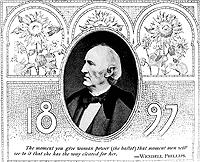
After slavery was abolished, Wendell Phillips went on to fight for women's suffrage.
The cause of union did not drive all Northerners. Abolitionists believed they were acting with divine guidance to fulfill God's will. They would tolerate neither compromise nor legal obstacle. Majority consent was not necessary. Wendell Phillips, a well-known abolitionist, declared, "One, on God's side, is a majority." Abolitionists saw slavery as an affront to God to be ended by any means necessary. Abolitionists incited riots throughout the South that resulted in hundreds of deaths.
Passions raged as hot in the South. Like Lincoln, Jefferson Davis also believed in the Declaration of Independence. He insisted that governments existed with the consent of the governed. Northern interference with popular Southern law was an affront to this ideals.
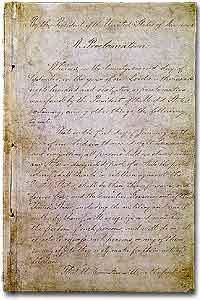
The Emancipation Proclamation was issued by Abraham Lincoln in 1863. It freed slaves in the states that had seceded and were not yet under Northern control.
Robert E. Lee, who did not favor secession, felt that the North was seeking to wrest from the South its dearest rights. Thomas "Stonewall" Jackson, a devout Presbyterian, believed that the Southern cause was a sacred one. He ascribed his successes to God's will, and preached that religious certitude to his troops.
Many Southerners believed the Northern position was an outright attack on the Southern way of life. They observed that the poverty suffered by Northern industrial workers created living conditions worse than those endured by Southern slaves. They also cited the Bible in defense of plantation life.
Southern legalists believed that the North was undermining the original intent of the Founding Fathers. The cornerstone of the American system was the state government, for which Confederates believed the Northerners had little respect.
Such fiery passions were difficult to reconcile. After decades of compromise attempts, these sacred beliefs finally raged against each other in the cauldron of war.
Instant Quiz