
32a. The Dred Scott Decision
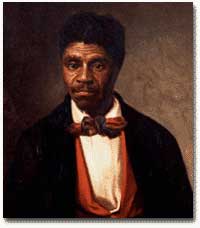
From the 1780s, the question of whether slavery would be permitted in new territories had threatened the Union. Over the decades, many compromises had been made to avoid disunion. But what did the Constitution say on this subject? This question was raised in 1857 before the Supreme Court in case of Dred Scott vs. Sandford. Dred Scott was a slave of an army surgeon, John Emerson. Scott had been taken from Missouri to posts in Illinois and what is now Minnesota for several years in the 1830s, before returning to Missouri. The Missouri Compromise of 1820 had declared the area including Minnesota free. In 1846, Scott sued for his freedom on the grounds that he had lived in a free state and a free territory for a prolonged period of time. Finally, after eleven years, his case reached the Supreme Court. At stake were answers to critical questions, including slavery in the territories and citizenship of African-Americans. The verdict was a bombshell.
- The Court ruled that Scott's "sojourn" of two years to Illinois and the Northwest Territory did not make him free once he returned to Missouri.
- The Court further ruled that as a black man Scott was excluded from United States citizenship and could not, therefore, bring suit. According to the opinion of the Court, African-Americans had not been part of the "sovereign people" who made the Constitution.
- The Court also ruled that Congress never had the right to prohibit slavery in any territory. Any ban on slavery was a violation of the Fifth Amendment, which prohibited denying property rights without due process of law.
- The Missouri Compromise was therefore unconstitutional.

The Chief Justice of the United States was Roger B. Taney, a former slave owner, as were four other southern justices on the Court. The two dissenting justices of the nine-member Court were the only Republicans. The north refused to accept a decision by a Court they felt was dominated by "Southern fire-eaters." Many Northerners, including Abraham Lincoln, felt that the next step would be for the Supreme Court to decide that no state could exclude slavery under the Constitution, regardless of their wishes or their laws.
Two of the three branches of government, the Congress and the President, had failed to resolve the issue. Now the Supreme Court rendered a decision that was only accepted in the southern half of the country. Was the American experiment collapsing? The only remaining national political institution with both northern and southern strength was the Democratic Party, and it was now splitting at the seams. The fate of the Union looked hopeless.