





7a. The Evolution of the Presidency
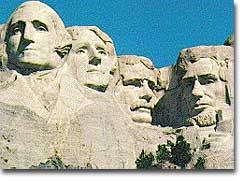
South Dakota's Mt. Rushmore memorializes four of America's greatest Presidents. Washington, Jefferson, Theodore Roosevelt, and Lincoln are carved into this spectacular monument.
The 21st Century dawned on a very different presidency than the one created at the end of the 1700s. Constitutional provisions limited the early presidency, although the personalities of the first three — George Washington, John Adams, and Thomas Jefferson — shaped it into a more influential position by the early 1800s. However, throughout the 1800s until the 1930s, Congress was the dominant branch of the national government. Then, throughout the rest of the 20th Century, the balance of power shifted dramatically, so that the executive branch currently has at least equal power to the legislative branch. How did this shift happen?
Constitutional Qualifications and Powers
Article II of the Constitution defines the qualifications, benefits, and powers of the presidency. The President must be at least 35 years old, and must have resided in the United States for no fewer than 14 years. Presidents must be "natural born" citizens. The Constitution states that the President should be paid a "compensation" that cannot be increased or decreased during a term. Congress determines the salary, which increased in 2001 to $400,000, doubling the salary that was set back in the 1960s.
Article II of the Constitution
The executive Power shall be vested in a President of the United States of America. He shall hold his Office during the Term of four Years, and, together with the Vice President, chosen for the same Term, be elected, as follows:
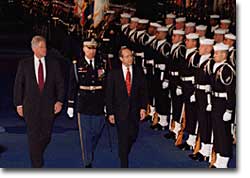
As Commander in Chief of the Armed Forces, the President is responsible for the Army, Navy, Air Force, Marine Corps, and Coast Guard. Here, President Clinton reviews troops at the Fort Myer base in Virginia.
Each State shall appoint, in such Manner as the Legislature thereof may direct, a Number of Electors, equal to the whole Number of Senators and Representatives to which the State may be entitled in the Congress: but no Senator or Representative, or Person holding an Office of Trust or Profit under the United States, shall be appointed an Elector.
[The Electors shall meet in their respective States, and vote by Ballot for two Persons, of whom one at least shall not be an Inhabitant of the same State with themselves. And they shall make a List of all the Persons voted for, and of the Number of Votes for each; which List they shall sign and certify, and transmit sealed to the Seat of the Government of the United States, directed to the President of the Senate. The President of the Senate shall, in the Presence of the Senate and House of Representatives, open all the Certificates, and the Votes shall then be counted. The Person having the greatest Number of Votes shall be the President, if such Number be a Majority of the whole Number of Electors appointed; and if there be more than one who have such Majority, and have an equal Number of Votes, then the House of Representatives shall immediately choose by Ballot one of them for President; and if no Person have a Majority, then from the five highest on the List the said House shall in like Manner choose the President. But in choosing the President, the Votes shall be taken by States, the Representation from each State having one Vote; A quorum for this Purpose shall consist of a Member or Members from two thirds of the States, and a Majority of all States shall be necessary to a Choice. In every Case, after the Choice of the President, the Person having the greatest Number of Votes of the Electors shall be the Vice President. But if there should remain two or more who have equal Votes, the Senate shall choose from them by Ballot the Vice President.]*
*Changed by the Twelfth Amendment.
The Congress may determine the Time of choosing the Electors, and the Day on which they shall give their Votes; which Day shall be the same throughout the United States.
No Person except a natural born Citizen, or a Citizen of the United States, at the time of the Adoption of this Constitution, shall be eligible to the Office of President; neither shall any person be eligible to that Office who shall not have attained to the Age of thirty five Years, and been fourteen Years a Resident within the United States.
[In Case of the Removal of the President from Office, or of his Death, Resignation, or Inability to discharge the Powers and Duties of the said Office, the Same shall devolve on the Vice President, and the Congress may by Law provide for the Case of Removal, Death, Resignation or Inability, both of the President and Vice President, declaring what Officer shall then act as President, and such Officer shall act accordingly, until the Disability be removed, or a President shall be elected.]*
*Changed by the Twenty-fifth Amendment.
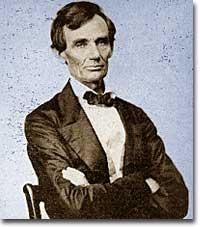
Sixteenth President Abraham Lincoln, captured here in a daguerreotype, strongly defended the preservation of the Union and often acted without congressional consent during the Civil War.
The President shall, at stated Times, receive for his Services, a Compensation, which shall neither be increased nor diminished during the Period for which he shall have been elected, and he shall not receive within that Period any other Emolument from the United States, or any of them.
Before he enter on the Execution of his Office, he shall take the following Oath or Affirmation:--"I do solemnly swear (or affirm) that I will faithfully execute the Office of President of the United States, and will to the best of my Ability, preserve, protect and defend the Constitution of the United States.''
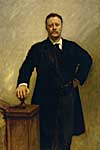
Theodore Roosevelt was a grand statesman, conservationist, warrior, and sportsman, who said leaders must "speak softly and carry a big stick."
The President shall be Commander in Chief of the Army and Navy of the United States, and of the Militia of the several States, when called into the actual Service of the United States; he may require the Opinion, in writing, of the principal Officer in each of the executive Departments, upon any Subject relating to the Duties of their respective Offices, and he shall have Power to grant Reprieves and Pardons for Offenses against the United States, except in Cases of Impeachment.
He shall have Power, by and with the Advice and Consent of the Senate, to make Treaties, provided two thirds of the Senators present concur; and he shall nominate, and by and with the Advice and Consent of the Senate, shall appoint Ambassadors, other public Ministers and Consuls, Judges of the Supreme Court, and all other officers of the United States, whose appointments are not herein otherwise provided for, and which shall be established by law: but the Congress may by Law vest the appointment of such inferior officers, as they think proper, in the President alone, in the courts of law, or in the heads of departments.
The President shall have Power to fill up all Vacancies that may happen during the Recess of the Senate, by granting Commissions which shall expire at the End of their next Session.
Section 3.
He shall from time to time give to the Congress Information of the State of the Union, and recommend to their Consideration such Measures as he shall judge necessary and expedient; he may, on extraordinary Occasions, convene both Houses, or either of them, and in Case of Disagreement between them, with Respect to the Time of Adjournment, he may adjourn them to such Time as he shall think proper; he shall receive Ambassadors and other public Ministers; he shall take Care that the Laws be faithfully executed, and shall Commission all the Officers of the United States.

Section 4.
The President, Vice President and all civil Officers of the United States, shall be removed from Office on Impeachment for, and Conviction of, Treason, Bribery, or other high Crimes and Misdemeanors.
The Constitution assigned the following powers to the President:
- Military power. The founders saw the importance of a strong military to protect the country and its citizens, but they named the President, a civilian, the "commander in chief" of the armed services. They were ever mindful of checking and balancing power, and they did not want a military general to seize the government.
- Diplomatic power. The President was given the power to make treaties with foreign nations, but not without the "advice and consent" of the Senate. Two-thirds of the senators must agree to a treaty the President signs, and if they do not, the treaty is not valid. The Constitution also provides that the President "shall receive ambassadors and other public ministers," which includes the duty of recognizing new nations, representing the United States to other countries, and performing related ceremonial duties.
- Appointment power. The Constitution gives the President the responsibility to appoint "Ambassadors, other public Ministers and Consuls, Judges of the Supreme Court, and all other Officers of the United States." Again, the Senate gives its "advice and consent," so that all appointments must be confirmed by a majority of the Senators voting.
- Legislative power. The President was given the power to veto legislation. Every bill that passes both houses of Congress must be submitted to the President, although Congress can get around the President in several ways. If the President fails to sign the bill within ten days, it becomes law anyway. Also, Congress may override a presidential veto by a vote of two-thirds of each house.
The Strengthening of the Presidency
Because the Constitution gave the President such limited power, Congress dominated the executive branch until the 1930s. With only a few exceptions, Presidents played second fiddle to Congress for many years. However, those exceptions — Andrew Jackson, Abraham Lincoln, Theodore Roosevelt, and Woodrow Wilson — provided the basis for the turning point that came with the presidency of Franklin Roosevelt in the 1930s.
Andrew Jackson, greatly loved by the masses, used his image and personal power to strengthen the developing party system by rewarding loyal followers with presidential appointments. Jackson also made extensive use of the veto and asserted national power by facing down South Carolina's nullification of a federal tariff law. Jackson vetoed more bills than the six previous Presidents combined.
Abraham Lincoln assumed powers that no President before him had claimed, partly because of the emergency created by the Civil War (1861-1865). He suspended habeas corpus (the right to an appearance in court), and jailed people suspected of disloyalty. He ignored Congress by expanding the size of the army and ordering blockades of southern ports without the consent of Congress.
Theodore Roosevelt and Woodrow Wilson each expanded the powers of the presidency. Roosevelt worked closely with Congress, sending it messages defining his legislative powers. He also took the lead in developing the international power of the United States. Wilson helped formulate bills that Congress considered, and World War I afforded him the opportunity to take a leading role in international affairs.
Franklin Roosevelt, who was elected four times to the presidency, led the nation through the crises of the Great Depression and World War II. Roosevelt gained power through his New Deal programs to regulate the economy, and the war required that he lead the country in foreign affairs as well.
So, the powers of the modern presidency have been shaped by a combination of constitutional and evolutionary powers. The forceful personalities of strong Presidents have expanded the role far beyond the greatest fears of the antifederalists of the late 1700s.