





13c. A Small, Small, World?
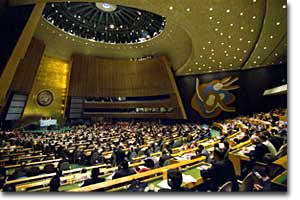
Delegates from the 185 member states of the United Nations convene in the General Assembly Hall to discuss the pressing global issues of our time.
"What happens in the farthest corner of the world now touches us almost instantly...The world has become a more crowded, more interconnected, more volatile and unstable place." -Ernest Boyer, "The Globe, the Nation, and our Schools," Kettering Review, 1984
The world is separated politically into countries. But does it always have to be? Checking a map from a few years ago reveals many changes in political boundaries. Looking at a map from 100 years ago shows almost total change. That fact is hard for Americans to realize because the borders of the United States have changed only twice over the past 150 years — to include the new states of Hawaii and Alaska. Is it possible that in the near future borderlines between countries will have little meaning?
Globalization
Ernest Boyer's quote above is a comment on globalization — the increasing tendency for many interests and issues to be shared by nations. Many globalists warn that the very future of the earth depends on countries cooperating to solve major problems like instability in the world economy, pollution, overpopulation, loss of natural resources, hunger, international conflict, and climate changes.
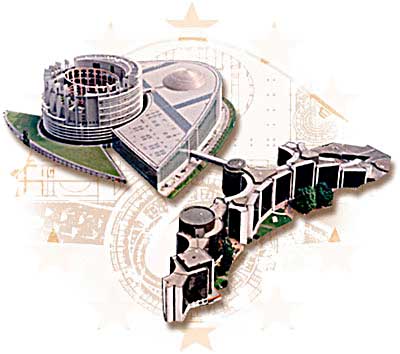
The European Parliament, the legislative branch of the European Union, holds plenary sessions once a month in Strasbourg, France. It also meets in Brussels and Luxembourg to exercise its three fundamental powers: the power to legislate, the power of the purse, and the power to supervise the executive branch (the European Council).
Revolutions in communications, travel, and technology make instant contact among nations possible. Many treaties and international agreements now bind countries together to address concerns over the economy, security, and the environment. Does this all mean that nations and governments as we know them today will disappear? Some observers think so. Some early signs include the following:
- International organizations. The 20th century saw new experiments with international peace organizations designed to solve disputes diplomatically rather than through war. The League of Nations, established just after World War I, was generally a failure since it could not prevent the advent of World War II. The United Nations replaced the League and has had a very mixed record as a referee in international conflicts. However, about 160 nations belong to the UN, and the organization is still alive and well after more than half a century.
- Regional organizations. Regional organizations have existed for many years, but some experts are seeing a blurring of national borderlines in many recent ones. An example is the European Union, which started as a effort to create a common marketplace among European nations with trade restrictions totally removed. But now nations are electing representatives to a European Parliament. Will shared political powers follow? NAFTA (North American Free Trade Agreement) binds Canada, the United States, and Mexico in a free trade zone. Many other regional organizations exist around the globe.

A Case for Independent Governments

While you're at school, children as young as five years old are working in factories to make the clothes and shoes that you and your classmates wear every day. Although globalization might mean freer trade and more rapid economic development, it has caused serious problems like sweatshops and child labor.
Most people cannot imagine nations ever entirely disappearing, even though the nation-state did not emerge in world history until the 18th century. There are many reasons why governments for individual countries still exist. Different people have different needs. Governments must vary according to the needs of the people they serve. Could the globe function under one world government, or even under tough restrictions from an international peace organization? People across the globe still have plenty of differences. According to this point of view, independent governments that are adapted to their citizens still make the most sense.
Competition among nations is a well-established pattern. How could the countries of Europe who have been at war for centuries agree to submit to a single government? How could and why should the United States compromise with other governments if it remains the world's largest military superpower? The citizens of these nations have difficulty yielding their sovereignty — the right to determine their own affairs — to supranational organizations.
Will globalization be the answer to current world dilemmas? Or does globalization ignore the need for the continuation of nation-states? Whatever the future holds, governments will be a part of the attempt to address issues and solve problems. The systems may change, but the goals of maintaining order, creating prosperity, and protecting rights are unlikely to change.