




11c. Economic Policy
With the New Deal, President Franklin D. Roosevelt aimed to reverse the effects of the Great Depression through heavy government spending. The Works Progress Administration (WPA) was one of many federal agencies he created to generate jobs and stimulate the stagnant economy.
Does the government direct the economy, or does the economy direct itself?
Until the 20th century the country abided by the laissez-faire policy, which required a free market with little intervention from government. With the Great Depression came Keynesian economics, or the opposite belief that the government should manage the economy. Today, United States economic policy lies somewhere in between — government should regulate and sometimes manage, but should allow a free market whenever possible. Political and business leaders disagree on how much control is enough.
Monetary Policy
Monetary policy is the government's control of the money supply. The government can control how much or how little money is in circulation by the amount that they print and coin. If too much money is out there, it tends to cause inflation, or the devaluation of the dollar. Too little money causes deflation, which can lead to a recession. The powerful arm of government that controls the money supply is the Federal Reserve System, which is headed by the Federal Reserve Board. The most important way that the "Fed" controls the money supply is by adjusting interest rates — high rates discourage borrowing money, which causes less inflation. The "Fed" can lower interest rates to stimulate borrowing, which encourages consumer spending.
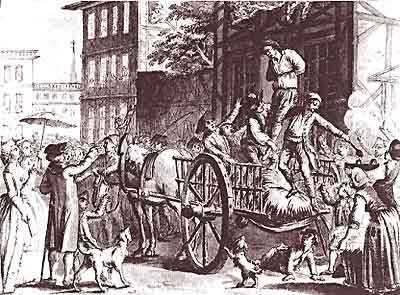
Taxation has long been a sensitive subject in American politics. In colonial times, tax collectors were often vilified and subjected to verbal and even physical abuse.
The Federal Reserve Board's seven members are appointed by the President and are approved by the Senate for 14-year, nonrenewable terms. The President may not remove them from office, so they function quite independently from any controls from the executive branch. The chair is elected by the Board for four years, and may be reelected. The Board heads the Federal Reserve System, which was created by Congress in 1913 to regulate the lending practices of banks. It consists of 12 regional banks, which in turn supervise a total of about 5,000 banks across the United States.

Fiscal Policy
Fiscal policy affects the economy by making changes in government's methods of raising money and spending it.
- Raising money. The most important way that the United States raises money is through taxation. About 40 percent of the government's total tax collections come from income taxes from individuals and businesses. Another 32% come from social insurance taxes, such as Social Security, Medicare, and unemployment compensation. Other sources of income are excise taxes on goods such as liquor, tobacco, and gasoline, estate and gift taxes, and tariffs. The government also may borrow money to finance its expenses. For example, it borrows money when it sells treasury bonds to citizens.
- Spending money. The federal budget is measured in trillions of dollars (4.4 trillion in 2019). Each year, the President submits a federal budget for approval by Congress for money to be spent starting in October of that year. More money is spent in three categories than in any others. The largest amount of money goes to entitlement programs, such as Social Security pensions for older Americans, unemployment insurance, Medicare, and federal retirement pensions. The second largest amount goes for national defense. Today about 16 percent of the total budget goes for defense, in contrast to 28 percent in 1987, when the Cold War was still on. The third largest amount — about 15 percent — pays interest on the national debt. Other expenditures are highway construction, education, housing, and foreign aid.
The chair of the Federal Reserve Board is the most visible figure in the sphere of monetary policy. The Federal Reserve's decisions and policies shape the financial lives of millions of people in the United States and abroad.
Within these two broad categories — monetary and fiscal policies — lies a great deal of room for disagreement. Some argue that government should be more "hands off" than it is and that taxes should be reduced. Others believe that the government should more actively control the economy and that taxes should be used to pay down the national debt. Many disagree on the amount of control that government should have, but no one questions the importance of government's setting a strong, effective economic policy.